What is anti-islanding, and what does the test check?
What is an anti-islanding test?
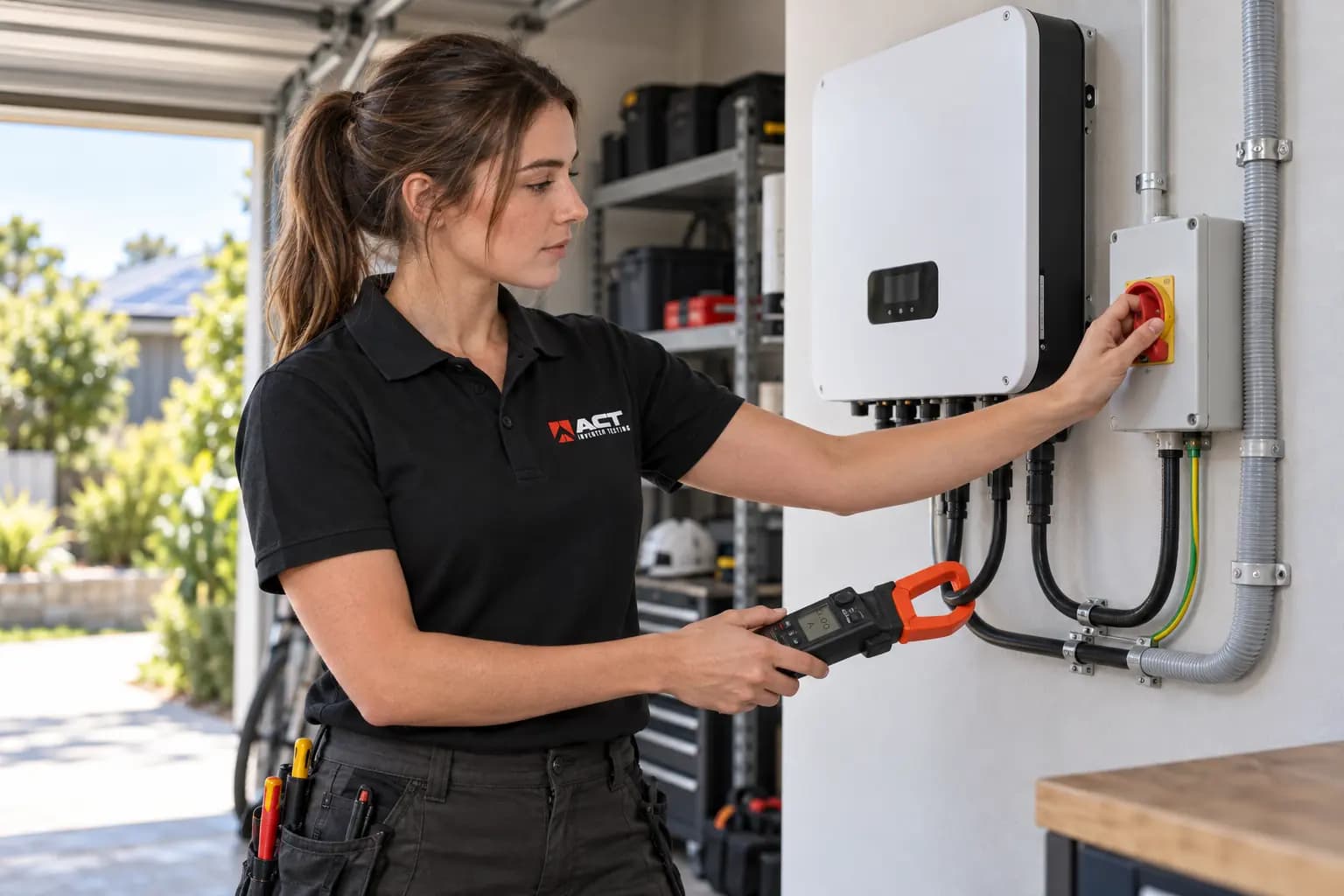
A timed check of your inverter's anti-islanding protection. Under Evoenergy's procedure an ACT licensed electrician turns off the inverter main switch and measures two things: the inverter must cease supplying power within two seconds of a loss of mains, and must not resume until mains have been present for more than 60 seconds.
What is anti-islanding protection?
The function that automatically disconnects your inverter from the network when there is a power interruption. Evoenergy says the mechanism protects its crews while they restore power, and the five-yearly test Evoenergy requires checks that it still works.
What is islanding in solar?
Islanding is when an inverter keeps supplying power into the network during an outage, leaving an island of live power in an otherwise de-energised section. Evoenergy calls it a serious safety issue that could lead to injury or death for its crews or for electrical contractors working inside the property. It can also damage equipment and appliances.
How does anti-islanding work?
Automatically. When there is a power interruption, the anti-islanding protection disconnects the inverter from the network, and it must not reconnect until mains have been present for more than 60 seconds, as Evoenergy's procedure requires. Evoenergy's technical requirements for small systems call for inverters certified as compliant with the Australian Standard AS/NZS 4777.2.
What is inverter testing?
In the ACT it usually means Evoenergy's periodic inverter test, also called the anti-islanding test or the five-yearly test. Evoenergy describes it as a simple testing process to confirm the operation of the AC inverter main switch and the installation's anti-islanding protection. It is a timed check, not a fault diagnosis or a repair.
Is the anti-islanding test the same as a solar system health check?
No. Evoenergy's procedure has two tests at the inverter main switch, 1a and 1b, plus two at the backup main switch, 2a and 2b, on battery systems that have one. They time how the system behaves when mains are lost and restored. A panel inspection or general health check is not part of it.
What is anti-isolation testing?
It is anti-islanding testing: the two words are easy to mix up. The test people mean is Evoenergy's periodic inverter test, which checks that an inverter stops supplying power when mains are lost and does not resume too soon. It starts at the inverter main switch, the AC isolation point immediately upstream of the inverter.
Do I have to get my inverter tested?
Do solar PV systems need anti-islanding testing in Canberra?
Yes, if they are connected to the grid. Evoenergy requires grid-connected inverters on its network to be tested at least once every five years, and in the ACT the electricity distribution network is Evoenergy's. That includes battery and hybrid inverters.
When is anti-islanding testing required in Canberra?
At least once every five years, and Evoenergy sends a reminder when the test is due. Evoenergy's procedure also sets a condition for the day: a system with PV panels connected must be producing more than 20 per cent of the rated output of the PV array or the inverter, whichever is less, so we test in daylight.
How often do inverters need to be tested?
At least once every five years. Evoenergy's FAQ notes that all owners that have an inverter at their property agreed to five-yearly testing during the application process, and that testing is required to comply with Evoenergy's embedded generation technical requirements.
Is an anti-islanding test optional?
No, not for a grid-connected inverter on Evoenergy's network. Evoenergy treats a system that hasn't completed its periodic testing as non-compliant, and non-compliant systems may be disconnected. If a system is identified as non-compliant, Evoenergy says it will let you know how to rectify it.
Why do I need a solar inverter test?
To check the inverter is still safely connected to the network. Evoenergy's FAQ says inverters must be tested at least once every five years to ensure they are safe for Evoenergy personnel, electrical contractors and the public, and that testing can also help avoid damage to the network and home appliances and minimise power quality issues.
Is the five-yearly inverter test a law in the ACT?
It is an Evoenergy requirement, set out in its Small Embedded Generation Technical Requirements, most recently published on 27 August 2026. Evoenergy treats a system that hasn't completed its periodic testing as non-compliant, and non-compliant systems may be disconnected.
Does an off-grid system need the test?
No. Evoenergy's technical requirements do not cover systems that are off-grid or operate in a non-parallel configuration, and generators with stand-alone inverters that do not connect to the Evoenergy network do not require approval from Evoenergy. The five-yearly test is for grid-connected inverters.
What should I do when Evoenergy's reminder arrives?
I got a letter from Evoenergy about inverter testing. What do I do?
Book the test. The test must be done by an ACT licensed electrician. Evoenergy does not do the test. Send us a photo of the notice and your suburb, and we confirm what is on site and book a time in daylight.
I can't get the test done in time. What should I do?
Evoenergy's FAQ says that if you cannot have the test done within 60 days, you need to contact Evoenergy and tell them why. Under certain circumstances it may grant an extension. Evoenergy's number is 13 23 86.
I'm renting. Who is responsible for the inverter test?
The property owner. Evoenergy's FAQ says that if you're renting, inverter testing is the responsibility of the property owner. If a reminder reaches you, pass it to your landlord or property manager. Evoenergy's procedure says a copy of the declaration must be provided to the owner of the installation.
I bought a house with solar. Do I need to get the inverter tested?
Yes. Evoenergy's FAQ says that as the new owner you are responsible for ensuring the inverter installation adheres to Evoenergy's rules, requirements and contractual obligations, and those include the five-yearly test. Evoenergy sends a reminder when the test is due.
Is ActewAGL the same as Evoenergy for the inverter test?
For the network, yes. From 1 January 2018, the network part of ActewAGL Distribution changed its name to Evoenergy. The five-yearly test predates the change, so older documents about it carry the ActewAGL name. The current procedure, FAQ and declaration are Evoenergy's.
Who can do the test?
Does Evoenergy do inverter testing?
No. The test must be done by an ACT licensed electrician. Evoenergy does not do the test; it publishes the procedure, sends the reminder and receives a copy of the completed declaration. Carrying out the test is the work we do.
Who can test a solar inverter?
An ACT licensed electrician. Evoenergy's procedure says the testing must only be carried out by an ACT licensed electrician. Its FAQ also notes that the company that installed your solar often has qualified staff offering this service.
Do you need an electrician to test a solar inverter?
Yes. Evoenergy's procedure warns that carrying out these tests involves working with live DC and AC voltages, and says the testing must only be carried out by an ACT licensed electrician. The electrician also completes and signs Evoenergy's Inverter anti-islanding test declaration.
Can I test my inverter myself?
No. Evoenergy's FAQ says you cannot do the test yourself: inverter testing involves working with dangerous voltages and can only be completed by a licensed electrician. Its procedure specifies an ACT licensed electrician.
Does the electrician have to be CEC or SAA accredited?
Not under Evoenergy's current documents. The procedure says the testing must only be carried out by an ACT licensed electrician, and the FAQ says any licensed electrician can test your inverter. Evoenergy's advice to check Solar Accreditation Australia accreditation is about choosing an installer.
What happens on the day?
Do I need to test the inverter main switch?
Yes. Tests 1a and 1b are carried out at the inverter main switch, which Evoenergy's procedure defines as the AC isolation point immediately upstream of the inverter. The procedure requires both the inverter main switch and the backup main switch, if there is one, to be tested.
Will my power be turned off during the test?
The electrician turns off the inverter main switch, and the backup main switch where there is one; Evoenergy's procedure does not call for your home's main switch to be turned off. Backup loads can lose power during the backup tests, though in most cases they stay energised, and we only proceed with your consent.
How long does an inverter test take?
Around 15 to 30 minutes, according to Evoenergy's FAQ. The test is normally quick, and it may take longer if problems are found or if you have more than one inverter to test.
Why does the weather affect my booking?
For inverters with PV panels connected, the procedure requires the test to run at a time of day when conditions allow the system to produce more than 20 per cent of the rated output of the PV array or the inverter, whichever is less. That rules out night, and heavy cloud can push a booking.
Do batteries and backup circuits need testing?
Does my solar battery need anti-islanding testing?
Yes, if its inverter is connected to the grid. Evoenergy's procedure covers battery, hybrid and battery-only inverters. Every inverter gets tests 1a and 1b at its inverter main switch; tests 2a and 2b are added only for battery systems that have both an inverter main switch and a backup main switch.
Will my battery backup turn off during the test?
Turning off the backup main switch can de-energise backup loads, depending on the battery's charge level and on whether there is a fault in the battery system. Evoenergy's procedure requires us to explain that risk before we start and to proceed only with your consent. In most cases backup circuits stay energised throughout.
What is a backup main switch?
It is the AC isolation point immediately upstream of a backup device, such as a Tesla Backup Gateway, that prevents a battery system from islanding while allowing some circuits to remain energised. Evoenergy's procedure calls it the backup system main switch, and tests 2a and 2b are carried out there.
Can a battery keep my home running in an outage?
Some can. Evoenergy says a battery may be able to provide part or all of your premises with backup supply during an outage, but to do this safely it must first disconnect from the Evoenergy network, and not all battery systems can offer this. Tests 2a and 2b time that behaviour at the backup main switch.
What paperwork do I get?
What paperwork do I get after the test?
The owner gets a copy of the declaration. The electrician completes Evoenergy's Inverter anti-islanding test declaration, keeps the original, gives the owner a copy and emails a copy to Evoenergy, pass or fail. Evoenergy encourages you to keep all test records while the inverter remains in service and connected to the network.
Do I have to send the results to Evoenergy myself?
No. Under Evoenergy's procedure the tester emails a copy of the declaration to distribution@evoenergy.com.au, and we do that for every test, pass or fail. Evoenergy's technical requirements also say the consumer shall maintain records of periodic tests, so keep your copy.
I have micro-inverters. Does each one need its own form?
Not if they share a main switch. Evoenergy's procedure lets multiple micro inverters of 1 kVA or less that are connected to the same inverter main switch use the same form. Otherwise each inverter needs its own form.
I have more than one inverter. Does each one need testing?
Yes. Evoenergy's declaration asks whether all inverters were tested, and each inverter needs a separate form, apart from micro inverters of 1 kVA or less that share an inverter main switch. Evoenergy's FAQ notes the test may take longer if you have more than one inverter to test.
What if the inverter fails, or the test isn't done?
What happens if my inverter fails the anti-islanding test?
The equipment has to be repaired or replaced, then retested, and the declaration goes to Evoenergy either way. An inverter may fail if it takes too long to disconnect or reconnects too quickly. Evoenergy's FAQ says that if in its opinion the inverter is unsafe, it will be disconnected and you will be advised in writing why.
Do I need Evoenergy approval to replace a failed inverter?
Yes. Evoenergy's technical requirements say all replacements require approval from Evoenergy, and your installer has to apply and receive that approval before completing the work. Evoenergy also advises making sure you receive a copy of its approval letter from your installer.
What happens if I don't get my inverter tested?
Evoenergy treats a system that hasn't completed its periodic testing as non-compliant, and non-compliant systems may be disconnected. Evoenergy's technical requirements say it may first ask for the system to be rectified within a specified timeframe, and will take steps to have it disconnected if that doesn't happen. The process may vary with the safety risk.
Is there a fine for not testing my inverter?
Evoenergy's documents describe disconnection, not a fine. Evoenergy treats a system that hasn't completed its periodic testing as non-compliant, and non-compliant systems may be disconnected.
What changes the cost of a test?
How much does a solar system anti-islanding test cost?
We quote each job rather than publish a price, and Evoenergy's FAQ notes the licensed electrician can provide a quote before the testing is undertaken. The quote depends on what is on site: how many inverters and declaration forms there are, and whether a battery with a backup main switch adds tests 2a and 2b.
More: Inverter testing cost
Does it cost more if I have more than one inverter?
It can, because there is more to test and record. Each inverter is tested and normally needs its own declaration form; micro inverters of 1 kVA or less on the same inverter main switch can share one. Evoenergy's FAQ says the test may take longer if you have more than one inverter to test.
More: Inverter testing cost
Where do you work, and how do I book?
Which parts of the ACT do you cover?
We work in Belconnen, Gungahlin, North Canberra, South Canberra, Woden Valley, Weston Creek, Molonglo Valley, Tuggeranong and the rest of the ACT. We are based in Canberra and come to you.
More: Service areas
How do I book an inverter test?
Call 0400 331 705 or use the booking form. Send a photo of your Evoenergy notice and your suburb, and tell us how many inverters you have and whether there is a battery. We confirm what is on site and book a time in daylight. Our hours are Mon–Fri 7am–5pm, Sat by arrangement.
More: Contact and booking
- Evoenergy, Periodic inverter testing procedure
- Evoenergy, Periodic inverter testing (FAQ)
- Evoenergy, Inverter anti-islanding test declaration
- Evoenergy, Solar safety
- Evoenergy, Solar and battery
- Evoenergy, Power quality
- Evoenergy, Small Embedded Generation Technical Requirements (PO0845, version 4), 27 August 2026
- Evoenergy, Service and Installation rules
- Evoenergy, About us