What is islanding, and why is it dangerous?
Islanding is when an inverter keeps supplying power into the electricity distribution network during an outage. Evoenergy describes the result as an island of live power in an otherwise de-energised section of the network.
Evoenergy's FAQ calls it a serious safety issue. Islanding creates safety issues for Evoenergy personnel working on the network, and for private electrical contractors working inside the property, that could lead to injury or death. It also interferes with network power quality and can damage equipment and appliances.
What is anti-islanding protection?
It is the protection that stops an inverter islanding. Evoenergy's FAQ says anti-islanding protection “ensures that the inverter is automatically disconnected from the network when there's a power interruption.”
Evoenergy's Solar safety page puts it plainly: your solar system will automatically cut out during a power outage, and this mechanism, called anti-islanding, protects its crews while they restore power.
What does the anti-islanding test measure?
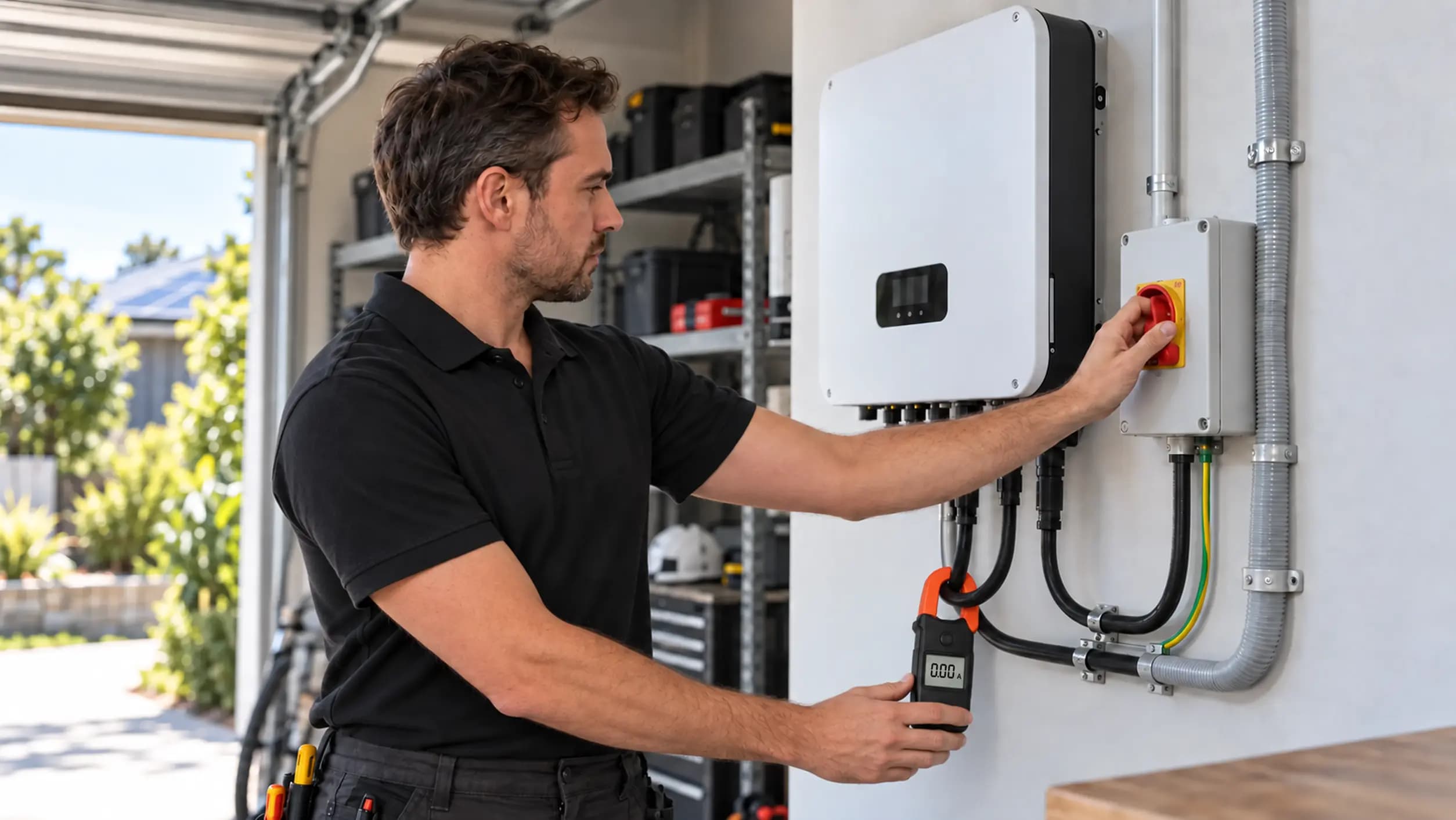
Two times, both at the inverter main switch. We put a voltage probe on the installation side of the switch, turn the switch off and time how long the inverter takes to stop trying to export power: that is test 1a. Then we restore mains and, with a current probe on the installation side of the switch, time how long the inverter waits before it starts exporting again: test 1b.
The inverter must cease supplying power within two seconds of a loss of mains.
The inverter must not resume supplying power until mains have been present for more than 60 seconds.
Evoenergy's declaration form records each time against the same marks. Battery systems with a separate backup main switch have two more tests, 2a and 2b, on that switch.
| Test | Switch | Requirement | Applies to |
|---|---|---|---|
| 1a | Inverter main switch | Ceases supply within two seconds | Every installation |
| 1b | Inverter main switch | Holds off for more than 60 seconds | Every installation |
| 2a | Backup main switch | Backup system ceases supply within two seconds | Battery systems with a backup main switch |
| 2b | Backup main switch | Backup system holds off for more than 60 seconds | Battery systems with a backup main switch |
Which switch is turned off, and will my power go off?
Tests 1a and 1b turn off the inverter main switch, not the main switch for the whole property. Evoenergy's procedure defines the inverter main switch as “the AC isolation point immediately upstream of the inverter.”
Battery systems with a separate backup main switch have a second switch to test. Tests 2a and 2b turn that switch off, and there is a chance that backup loads lose power. In most cases they stay energised, and the procedure has a consent step for it, set out under batteries below.
Why does the test need daylight?
The test times how long the inverter takes to stop exporting, so a solar inverter has to be producing power when the switch goes off. Evoenergy's procedure sets the minimum.
For inverters with PV panels connected, the test must run at a time of day when conditions allow the system to produce more than 20 per cent of the rated output of the PV array or the inverter, whichever is less.
The declaration form asks for the power output before the test and whether it met that condition. If it did not, the form says you must wait until it does before valid testing can be done. The DC supply from the solar array stays connected to the inverter for all the tests.
So we book daylight slots, and heavy cloud can mean moving a booking.
What changes for batteries and backup circuits?
Every battery system gets tests 1a and 1b on the inverter main switch. Some also have a backup device, such as a Tesla Backup Gateway, that prevents the system from islanding while keeping some circuits energised. Evoenergy's procedure calls the AC isolation point immediately upstream of that device the backup main switch.
Tests 2a and 2b repeat the two timings on the backup main switch. They apply only to battery systems that contain both an inverter main switch and a backup main switch, and they are recorded on their own page of the declaration.
Turning off the backup main switch can de-energise backup loads, depending on the battery's charge level and on whether there is a fault in the battery system. Evoenergy's procedure requires us to explain that risk before we start and to proceed only with your consent. In most cases backup circuits stay energised throughout.
How hybrid and battery-only inverters are set up for the test, and what to tell us before you book, is on our page about battery and backup systems.
Which standard sits behind the test?
AS/NZS 4777.2, through Evoenergy's own technical requirements. Standards Australia publishes AS/NZS 4777.2:2020, Grid connection of energy systems via inverters, Part 2: Inverter requirements, which covers inverters connected to the grid at low voltage.
Evoenergy's technical requirements for small systems (PO0845, version 4, published on 27 August 2026) require the inverter system to be tested by an authorised testing laboratory and certified as compliant with AS/NZS 4777.2. They also require active anti-islanding protection to be implemented as per AS/NZS 4777.2, and to operate the automatic disconnection device within two seconds of disruption to the power supply from the grid.
That certification happens in a laboratory. The five-yearly test checks the installed system on site: PO0845 says to “perform periodic verification of the system every five years as per the Evoenergy periodic inverter test procedure.” The pass marks in that test, including the more than 60 seconds, come from Evoenergy's procedure and declaration form.
Is an anti-islanding test the same as a solar health check?
No. Evoenergy's procedure describes “a simple testing process to confirm the operation of the AC inverter main switch and testing of the anti-islanding protection of the installation.” Its tests are 1a and 1b, plus 2a and 2b where a battery system has a backup main switch, recorded on Evoenergy's declaration.
Panel inspections, cleaning and wider system health checks are not part of Evoenergy's requirement. Anything offered alongside the test is a separate service.
Can I do the anti-islanding test myself?
No. Evoenergy's FAQ says you cannot do the test yourself, because inverter testing involves working with dangerous voltages and can only be completed by a licensed electrician. Its procedure warns that the tests involve working with live DC and AC voltages.
The test must be done by an ACT licensed electrician. Evoenergy does not do the test.
Evoenergy also advises that even in an outage, or if your inverter is switched off, you should always treat your system as live.
To have the test done, book with us or call 0400 331 705. If Evoenergy has sent you a reminder, our page on the Evoenergy inverter test covers what to do, the paperwork and what happens if an inverter fails.
What else do people ask?
More answers are on our inverter testing FAQs page.
How does anti-islanding work?
When mains supply is lost, the inverter's protection disconnects it from the network automatically. When supply returns, it waits before exporting again. Evoenergy's procedure sets both limits: stop supplying power within two seconds of a loss of mains, and do not resume until mains have been present for more than 60 seconds.
What is inverter testing?
Evoenergy calls it periodic inverter testing: the anti-islanding test on this page, which grid-connected inverters on its network need at least once every five years. It is also called the five-yearly test, the PV inverter test or, misheard, anti-isolation testing. It checks the protection timings, not the inverter's output or general condition.
Do I need to test the inverter main switch?
Yes. Evoenergy's procedure says both the inverter main switch and the backup main switch, if present, are required to be tested. Tests 1a and 1b are done on the inverter main switch at every installation, and tests 2a and 2b on the backup main switch where there is one.
I have micro-inverters. Does each one need its own form?
Not always. Evoenergy's procedure says each inverter needs its own form, except multiple micro inverters of 1 kVA or less connected to the same inverter main switch, which can share one form.
How often do inverters need to be tested?
In the ACT, at least once every five years. Evoenergy requires grid-connected inverters on its network to be tested at that interval, and sends a reminder when the test is due. What to do when it arrives is on our page about the Evoenergy inverter test.
- Evoenergy, Periodic inverter testing procedure
- Evoenergy, Periodic inverter testing (FAQ)
- Evoenergy, Inverter anti-islanding test declaration
- Evoenergy, Solar safety
- Evoenergy, Small Embedded Generation Technical Requirements (PO0845, version 4), 27 August 2026
- Standards Australia, AS/NZS 4777.2:2020 Grid connection of energy systems via inverters, Part 2: Inverter requirements, 18 December 2020